7 Ways to Integrate Social Media and PR for Business Growth
Dayana Mayfield
on
Social Media
Social media drives rapid business growth by increasing brand visibility, generating leads, and influencing direct sales at every stage of the buyer journey. Platforms like TikTok, Instagram, and YouTube now account for more than 60% of product discovery, surpassing traditional search engines and reshaping how consumers research brands and make purchasing decisions.
That shift makes a strong social media PR approach more important than ever. Businesses that combine public relations with a clear PR social media strategy can amplify brand credibility, strengthen audience trust, and create consistent messaging that drives long-term growth across multiple digital channels.
How? Let’s take a look.

Why should you integrate social media and PR?
Public Relations (PR) is all about building reputation, shaping public perception, and strengthening relationships with audiences. Social media, on the other hand, focuses on creating content, starting conversations, and distributing messaging to massive online audiences. Both are powerful on their own, but combining them creates a far more effective growth strategy for modern businesses.
Today, PR can no longer exist independently of social media. Consumers discover brands, research products, and form opinions online before making decisions. In fact, 54% of consumers use social media to research brands and products, making platforms like Instagram, TikTok, and LinkedIn essential parts of brand communication. That’s why integrating social media and PR is no longer optional for businesses that want to stay visible and competitive.
It helps you reach new audiences
Social media gives brands direct access to audiences at a scale traditional PR alone cannot match. PR builds authority and trust through media coverage, thought leadership, and reputation management, while social media amplifies those messages to larger and more targeted communities.
As Chris Brogan famously said, “Social media puts the public into PR and the market into marketing.” That combination allows businesses to extend the lifespan and reach of every campaign, announcement, or product launch.
For example, a positive media mention can quickly become a social campaign, a short-form video, a customer discussion thread, or user-generated content shared across multiple channels. Instead of reaching one publication’s audience once, brands can continuously repurpose PR wins to attract new followers, leads, and customers organically.
It strengthens trust and credibility
Consumers trust brands that maintain a strong and authentic online presence. PR helps shape credibility, while social media allows businesses to interact with audiences in real time. Together, they create a more transparent and human brand image.
This matters because social experiences directly influence customer advocacy. Research shows that 71% of consumers are more likely to recommend a brand after having a positive experience on social media. A coordinated PR and social media strategy helps businesses create those positive experiences consistently through customer engagement, storytelling, community management, and responsive communication.
It supports digital transformation
Effective digital transformation goes beyond simply building a website or creating social accounts. It involves aligning online and offline communication, including tools such as a LAN messenger, into one connected strategy that supports long-term business growth.
An integrated PR and social media strategy helps businesses unify messaging across digital channels, media outreach, customer engagement, and brand storytelling. This creates a seamless experience for audiences while strengthening both digital reputation and real-world relationships.
In today’s marketing environment, brands that separate PR from social media often struggle with inconsistent messaging and missed opportunities. Integration ensures campaigns feel cohesive, timely, and relevant across every touchpoint.
It brings brands closer to their audience
At its core, PR is about connecting with the public, and the modern public spends a huge amount of time on social media. Integrating PR with social platforms helps businesses communicate directly with audiences, respond to feedback faster, and participate in conversations that matter to customers.
As David Meerman Scott explained, brands gain attention when they provide value and create something worth talking about. Combining PR credibility with social media engagement helps businesses do exactly that while building stronger awareness, trust, and long-term growth.
It improves crisis communication and reputation management
A strong PR social media strategy helps brands respond quickly when issues arise online. News and customer reactions spread fast across platforms like TikTok and Instagram, so businesses need coordinated communication that keeps messaging clear and consistent.
This matters even more for younger audiences. Among Gen Z, 52% say they trust brand or product information found on social media more than information from Google or AI chatbots, while 41% use social media first when searching for information online. That means a brand’s social presence directly influences public perception during both positive and negative situations.
PR teams can manage official responses and media communication while social teams monitor conversations and address customer concerns in real time. Many successful social media PR examples like KFC turning a supply chain crisis into a viral apology campaign show how integrated communication can protect brand reputation. A strong PR social media strategy helps businesses correct misinformation faster, maintain transparency, and keep messaging consistent across every channel during sensitive situations.
7 ways to integrate social media and PR for business growth
So, now you know why it's a good idea to integrate social media with your PR strategy. But how can you do this successfully?
Here are seven tips to help you out
1. Take social media seriously

In order to get the best PR from your social media, you need to remake your growth mindset with social media front and center.
What does this look like in practice? Here are some tips:
Be consistent with posting. Don't just hop onto your social media platforms when you've got a conveniently shareable photo. Create social media posts and release them on a regular and consistent basis.
Engage. Keep eyes and ears on your social media posts, and actively engage with things like comments, shares, and so on. Listen to what people are saying about your posts, draw lessons from what you hear, and engage positively with your audience where appropriate.
Build a solid social media strategy. Give your social media marketing the same strategic status as you would televised campaigns. A good social media strategy will help you to understand the importance of social media in your overall PR landscape, and enable you to maximize the impact of your social media activity.
Consider how everything will look on social media. When designing anything for traditional media outlets, consider how it will look on social media. Even if you don't add social sharing buttons to your press releases etc (more on that in a moment), it's likely that any piece of content or PR you put out there will end up on social media in one form or another. So, think about how it will look and play out on social media whenever you're designing any form of content, appearance, interview etc.
Integrate marketing campaigns strategically. Extend this strategic approach to encompass your broader marketing initiatives, ensuring they are crafted to blend seamlessly with your social media and PR efforts. This integration is key to maximizing reach and impact, fostering a cohesive presence across all platforms. You can use an AI image description generator to easily convert PR features into social media posts.
By taking social media seriously and increasing its strategic importance to your business, you will make it a lot easier to integrate your social media presence with your PR in meaningful, impactful ways.
2. Add social sharing buttons to press and media pieces
This one is relatively simple to do, but can have an impressively wide-ranging impact. Embed social media options into PR pieces for traditional channels. Press releases are the obvious one here, but this also goes for things like interviews, event announcements, and more.
Why should you do this? Well, as we mentioned above, it's highly likely that anything you put out into the world will end up on social media one way or another. Whether it's people posting photos and videos of your events or sharing press about you, it's impossible to avoid getting on social media if you do something even slightly noteworthy.
So, don’t try to avoid it. Instead, you should take control of it. Accept that social media is always going to be a factor in your PR, and lean into it.
By adding social sharing buttons to your PR materials, you make it a lot easier for people to share your stuff in ways that work well for you. Rather than screenshots of interviews taken out of context or blurry videos of your team members speaking at events, curate your own press releases and videos and make it easy for people to share them.
This kind of integrated business planning gives you a much greater element of control over what gets shared, and spreads that positive PR over a wider social audience with ease.
Here, for example, is a press release from Nike. The 'Share' button is prominently displayed right at the top of the page:

3. Build your business network through social media
Any PR pro will tell you that "It's not what you know, it's who you know". So, one of the best ways to bring PR and social media together is to get to know people through social platforms. Use social media to gather a network of useful professional contacts around your brand.
Building a business network through social media is a big topic in and of itself. If you're not sure where to start, try these ideas:
Join relevant industry groups on platforms like LinkedIn, and contribute to discussions.
Write guest posts for other brands. Blogs, reviews, interviews, and so on are all great content that other brands can use with the added bonus for you that you make a new contact and get your name out there.
Use business lead generation companies. Whether you work B2B or B2C, lead generation and networking require many of the same skills and tactics, so it's as easy for specialist lead generation companies to pull in business contacts as it is for them to pull in business clients.
Keep up to date with relevant industry news, topics, and so on. This will tell you which trends and hashtags to follow and help you to contribute to online industry discussions in meaningful ways which will build your reputation (and your network with it!)
Hop onto hashtags wherever you can, and contribute to them where relevant. For example, if you are a hair salon brand looking to boost your marketing campaigns and a starlet's new style has gained a trending hashtag, maybe post your own take on that style with that hashtag. This will gain you attention and followers within your community, as well as showcase your abilities.
4. Use social media channels to build community

As well as building your network, use social media to engage with your target audience in ways that go beyond simply posting marketing. Go into social media with a PR mindset as well as a social marketing mindset, and engage with your public through social channels. Don’t limit yourself to simply posting content and engaging with the odd commenter. Instead, try to build community through social media.
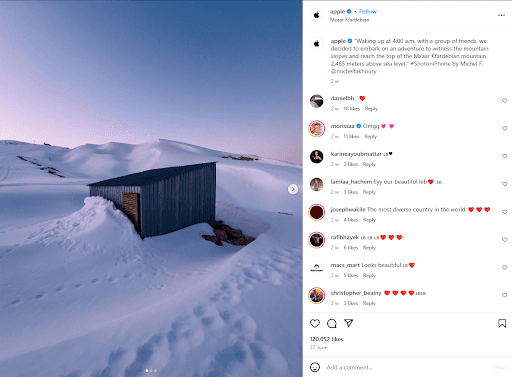
How can you do this? Here are some ideas:Leverage user-generated content. Public relations teams love UGC. User-generated content asks your target audience to get involved with content creation through things like hashtags, games, reviews, and so on. This makes your users feel more involved with your brand, while also showing the wider world exactly why people love you.
Here is an example from Apple, which asks users to show off the capabilities with the iPhone by sending in iPhone shots with the hashtag #ShotOniPhone:
Engage with your audience. Respond to comments, ask questions, and generally make your brand/follower relationship a two-way street.
Reward your audience for following you with things like competitions and giveaways.
5. Leverage good PR on social media through cross-posting and hashtags
This may sound obvious, but one of the biggest advantages of social media for PR is that it gets your good PR out to a wide audience. So, make sure it's doing that job properly by putting all good PR on social media.
Ideally, you should do this as part of a coherent PR/social media strategy consisting of carefully curated PR opportunities combined with social media posts, content marketing, catchy hashtags, and plenty of follow-up engagement from both your social media teams and your PR teams.
But if you don't have the time or resources to roll out a full PR/social media campaign, simply posting your good PR on your social media and loading it up with relevant hashtags will work wonders. Here's an example of cross-posting good PR from a Michigan engineering firm:

6. Build social media into your crisis management plans
Crisis management is part of what a good PR team does, and it's really important that this aspect of their work incorporates social media in a big way.
Integrating social media and crisis management involves things like:
Working out PR protocols for social media disasters (for example, getting review-bombed or going viral for something bad).
Working out a social media plan for PR disasters (for example, figuring out how and when to address bad PR with social media posts).
Appointing social media crisis management officers, who will have both the PR and social media skills needed to step in and fight fires when needed. Tools like Marlee can help you understand how people on your team communicate and handle pressure, so those roles go to the right person before a crisis hits.
Investing in social media analytics tools that will alert you quickly if you start trending for the wrong reasons on social platforms.
7. Use the right tools and techniques
There are a wealth of tools and platforms out there which can boost both your PR and your social media, and combine them for maximum business growth.
For example, social media aggregator tools let you embed social feeds wherever you need them, which is great for keeping people informed, building your social audiences, and quickly getting good PR out there.
Similarly, good analytics tools will tell you how your posts and campaigns are doing across your social networks, and let your PR team know if anything's trending. This enables your PR gurus to capitalize on good social trends and work quickly to put out social media fires.
There's an astonishing amount of martech, social media tools, and PR platforms available, and most of them will help you integrate your PR and social media in innovative and useful ways. So, shop around and build a tech stack that works for you.
Integrate social media and PR for great business outcomes
Social media is great for amplifying the messages that your PR teams curate. By integrating social media with PR, you can reach new audiences, deepen your brand/customer relationships, be responsive and proactive with both positive and negative PR, and generally build both your brand and business faster.
The right tools can make it easy to integrate social media and PR, so make sure that you have the very best in your tech stack.
FAQs
What is PR in social media?
Social media PR is the practice of using social platforms to manage brand reputation, strengthen public perception, and build relationships with audiences. It combines traditional public relations with real-time engagement on platforms like Instagram and LinkedIn to increase visibility, credibility, and audience trust.
What are social media PR examples?
Social media PR examples include brands responding transparently during crises, promoting media coverage across social platforms, collaborating with influencers, or launching viral campaigns. Companies like Nike and KFC have used social media PR to strengthen customer trust, manage public reactions, and increase engagement during major campaigns.
Is social media public relations different from a social media press release?
Yes. Social media public relations is a broader strategy focused on reputation management, audience engagement, and brand communication across social platforms. A social media press release is a specific announcement designed for online distribution and sharing. Press releases are one tactic within a larger social media PR strategy used to generate awareness and media attention.
Why is social media important for PR strategies?
Social media is essential for PR strategies because it allows brands to communicate directly with audiences in real time, control narratives, and amplify earned media. It also boosts visibility, as platforms like TikTok and YouTube drive discovery, engagement, and trust, making PR efforts more impactful and measurable.
Check out Curator’s social media aggregator if you’re interested in seeing how great tech can transform your PR.
Previous post: