You have probably screenshotted a customer's Story, meaning to use it later. Then you opened your camera roll weeks on and could not remember what it was even about.
I have set up Instagram Stories feeds on more sites than I can count, and the same thing trips people up every time. The Stories are already gone by the time anyone thinks to display them.
Curator is installed on more than 100,000 websites, and Stories is one of the Instagram source types teams reach for first. UGC is a powerhouse for trust, and Stories are its most overlooked format.
This guide covers why Stories deserve a bigger role, five ways to get customers posting them, and seven steps to display them on your site.
Why Stories deserve a bigger role in your UGC strategy
Reels and feed posts get the attention. Stories get the honesty.
I personally prefer Stories over feed posts for social proof, because customers say things in a Story they would never caption on a permanent post.
A Story is low stakes. Nobody agonizes over the caption or the lighting. What you get is a spontaneous endorsement, worth more to a first-time visitor than anything you could shoot. Our examples of UGC Instagram posts show what that looks like.
The quality that makes Story UGC feel unfiltered also makes it hard to keep. It expires in 24 hours. Everything here follows from that, including how Stories fit your wider Instagram UGC strategy.
5 ways to get customers posting Stories about you
You cannot aggregate Stories nobody makes. These five formats give customers a reason to open the camera.
1. Run a Q&A campaign
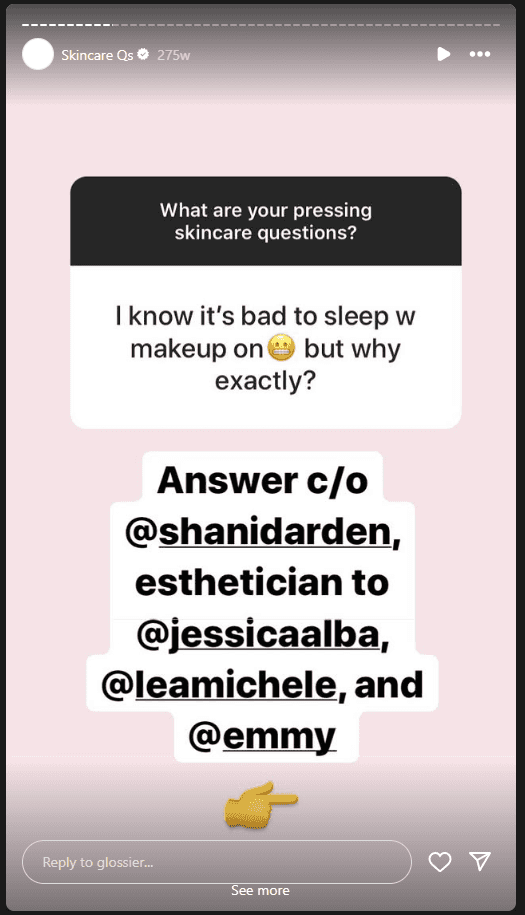
Invite customers to ask questions around your expertise and then showcase the questions and answers in a Story. For example, Glossier's "Skincare Qs" answers questions about skincare from their followers. This produces super engaging and helpful content.
The question sticker does the work here. It gives someone a low effort reason to message you, and every reply is content you did not have to make.
2. Turn customer wins into a Story series
Fitbit created "Fitbit Stories" where they reach out to their users to find the many ways their product is helping people. They then compiled these successes. Including the CTA to share your own story keeps the engagement high and the content growing.
A named, recurring series works harder than a one off ask. Customers see the format before they contribute, so they know what you want.

3. Ask for unboxing and first reaction videos
Encourage customers to share their initial reactions when they receive or try your product. ColourPop Cosmetics' "?" Story features customer unboxings of their mystery boxes. This provides entertaining content that is both relatable and exciting.
Unboxing content arrives with genuine surprise in it. You cannot direct that, and viewers spot the difference instantly. A first reaction filmed on a phone often beats a polished product video.

4. Show your products out in the real world
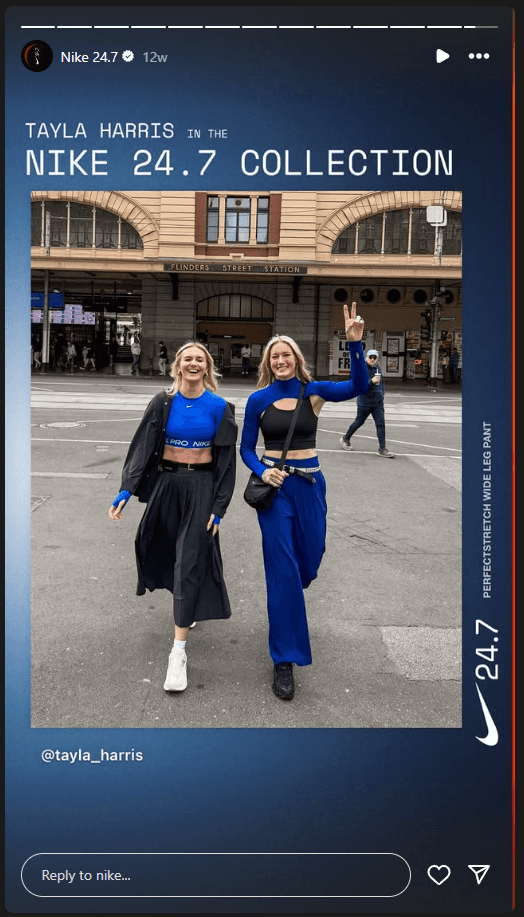
Nike's "24.7" Story showcases their 24.7 collection being worn by real athletes around the world.
Seeing a product in ordinary settings, on people who are not models, closes a gap the product page cannot. Your customer stops imagining how it might look.
5. Highlight fans of your product
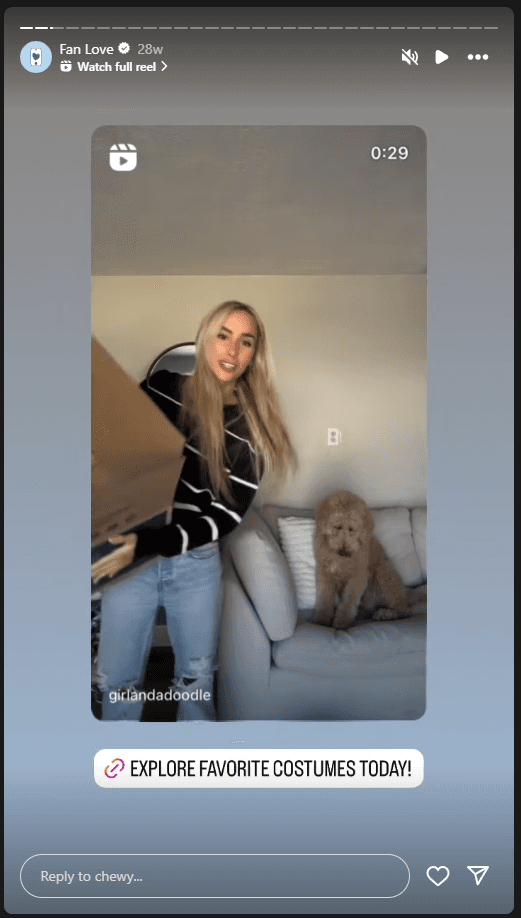
Instagram Stories are a great way to highlight the fans and supporters of your business. That is what Chewy's "Fan Love" Story is dedicated to. They compile content centered around their fans.
Featuring a customer publicly is a reward, and rewarded customers post again. One shoutout often produces two or three more from people who watched it happen.
"Set Stories to manual approval even when the content is your own. Stories get posted fast and loose, and the ones you would never put on a homepage are exactly the ones auto approval lets through." — Mike Hill, CEO and Co-founder, Curator
What a Stories feed can actually pull, and what it leaves behind
Before you connect anything, know what a Stories source brings across.
Your own Stories, inside a 24 hour window
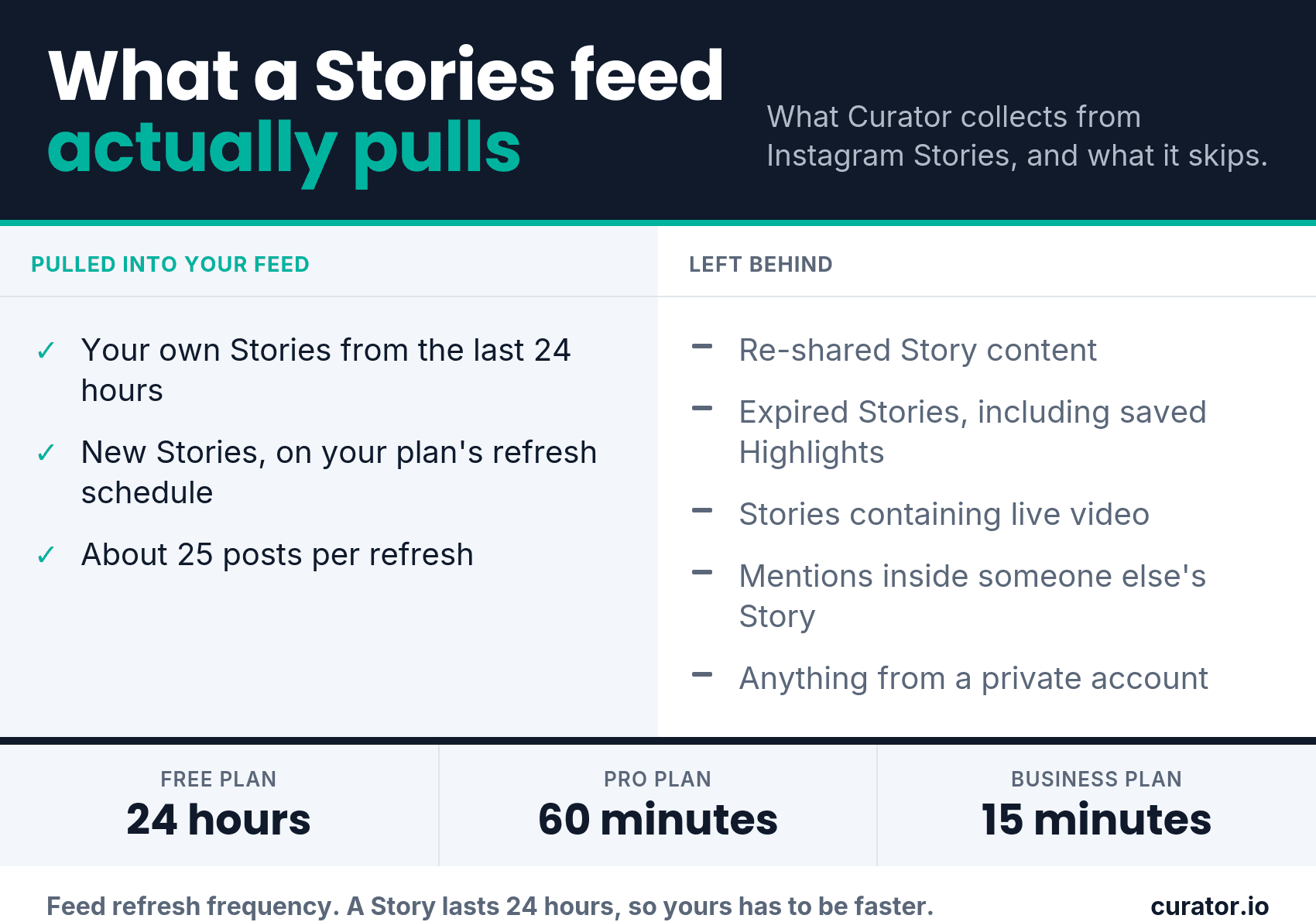
A Stories source connects to your own Instagram Business or Creator account, linked to a Facebook Page. It pulls Stories from the last 24 hours, then collects new ones on your refresh schedule.
Curator refreshes free plan feeds every 24 hours, Pro every 60 minutes, and Business every 15 minutes (Curator help documentation, 2026).
"A Story lives for 24 hours. If your feed only checks for new content once a day, you will miss half of them. Match your refresh rate to how fast the content disappears." — Thomas Garrood, Co-founder, Engineering, Curator
What does not come through
Curator's documentation is specific:
Re-shared Story content cannot be pulled
Expired Stories cannot be pulled, including ones saved to Highlights
Stories containing live video are not supported
Mentions made inside someone else's Story cannot be pulled
Private accounts are out entirely
You cannot point a feed at your customers' Stories and expect them on your site. The source looks at your account, not theirs.
One ecommerce team could not understand why their Stories feed looked half empty. They posted daily on the free plan, which refreshes every 24 hours. Their Stories expired before the feed saw them.
So how do you get customer Stories onto your site
Publish approved content from your own account, where the Stories source can collect it. For customer feed posts, use the Tagged and Collab Posts or Mentions sources instead.
Every route starts with permission.
Getting permission, and why a tag is not enough
Here’s what you need to know about using Instagram Stories as UGC for your brand.
A tag is not permission
Someone tagging your brand is not the same as giving you their content. Neither is your branded hashtag. The creator holds the copyright either way.
The stakes climb when the content leaves Instagram. Resharing to your own Story is one thing. Putting a customer's face on a page that sells something is another.
I ask permission for every single one, including the Stories tagged with our own hashtag. Nobody has ever said no, and it takes about forty seconds.
How to ask, and what to say
Send a DM with four beats. Name the specific thing you liked, say where it will appear, say how you will credit them, then ask directly.
Timing is the hard part. A Story is gone in 24 hours, so ask while it is still on screen.
Tracking who said yes
Permission granted in a DM disappears into a thread nobody can find later. That is fine until someone asks you to prove it.
Curator's Rights Management add-on sends rights requests and tracks who replied, so approvals live somewhere searchable.
Permission and moderation are separate gates. An approved Story still has to clear your feed rules, which our guide to moderating user generated content covers.
I keep a simple record of who approved what and when. The one time a creator changed their mind, having the original message meant it took five minutes to sort out.
Putting the approved Stories on your site
The setup is the easy part, and takes about five minutes.
Connect Instagram and add Stories as your source
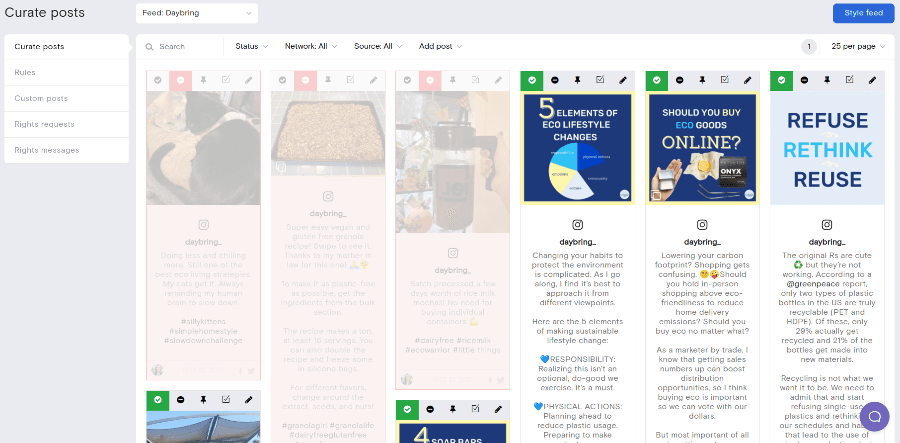
Approve the Stories you want in the Curate tab
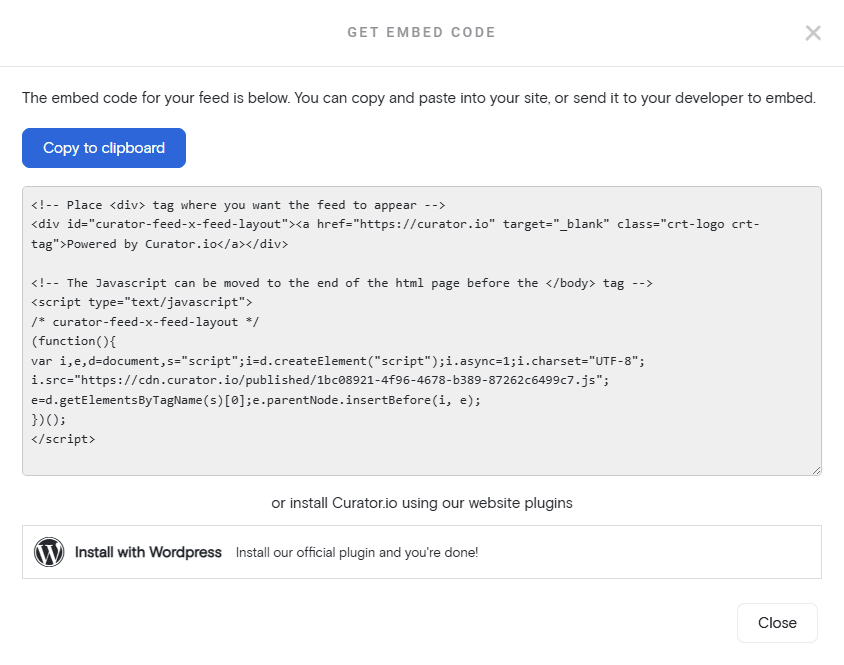
Paste the embed code where you want the feed to appear
Pick a layout template built for vertical content, since Stories are shot for a phone screen. For the full walkthrough with screenshots at every step, follow our guide to embedding Instagram Stories on your website.
UGC Instagram Stories FAQs
Can I display another person's Instagram Story on my website?
Not directly. A Stories source connects to your own Instagram Business or Creator account and pulls from that account. A customer's Story will not appear just because it mentions you. Ask permission, then publish it yourself.
Do I need an Instagram Business account to use Stories as a feed source?
Yes. Instagram only allows third party tools to access Stories through a Business or Creator account linked to a Facebook Page. Personal accounts are not supported. Switching over takes a few minutes in your Instagram settings.
What happens to my Stories feed after the Stories expire?
The Stories stay on your website. Once a Story is pulled in and approved, it lives in your widget rather than on Instagram, so the 24 hour clock stops applying. What expiry affects is collection, not display.
Do I need permission if a customer tagged me in their Story?
Yes. A tag tells you the content exists and that the customer is happy to be associated with you. It transfers no rights, and the creator still owns the copyright. The same goes for your branded hashtag, even when you have asked people to use it.
Ready to get Instagram Stories up on your website? Try our free forever feed.
Previous post: